
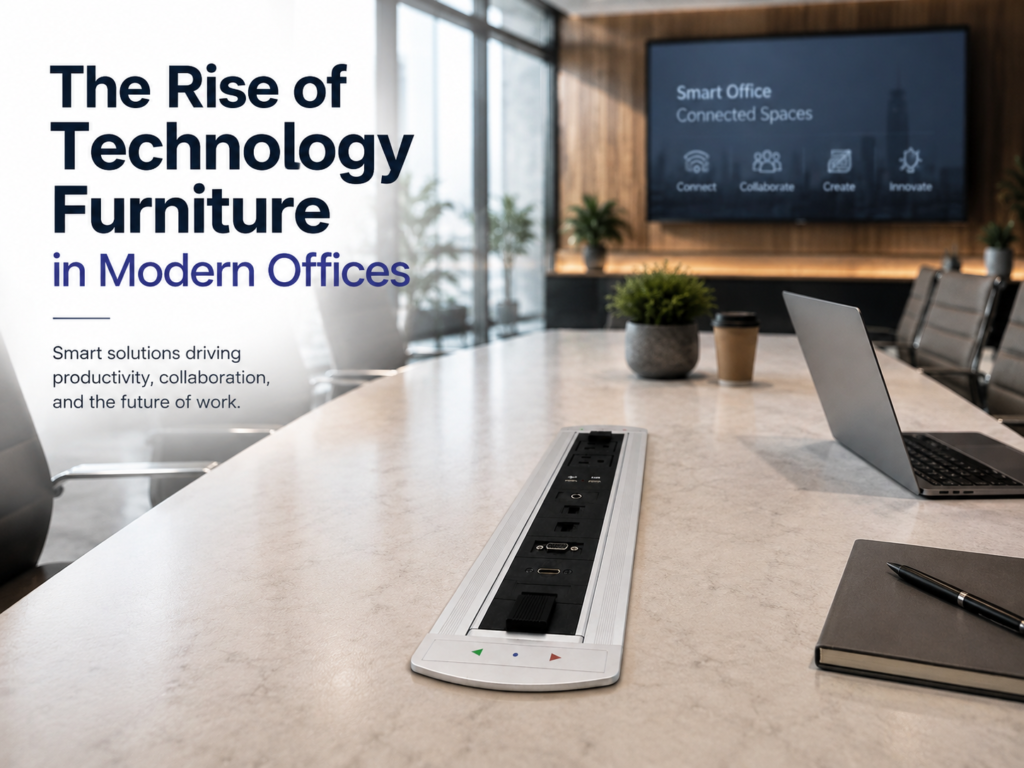
How Power, Connectivity and Smart Design Are Shaping the U.S. Workplace
The modern office is changing rapidly.
Employees are no longer tied to one desk or one device. Laptops, smartphones, tablets, video conferencing and AI-powered tools have created a workplace where people move between individual workstations, meeting rooms, collaboration areas and flexible spaces throughout the day.
As a result, office furniture is evolving from something people simply work at into something that actively supports how they work.
This is the rise of technology furniture.
What Is Technology Furniture?
Technology furniture integrates workplace infrastructure directly into desks, tables and workstations.
It can include:
- AC power
- USB-C charging
- USB-A charging
- USB Power Delivery
- Data connectivity
- HDMI and AV connectivity
- Wireless charging
- Cable management
- Integrated power distribution
- Meeting-room connectivity
The objective is simple:
Make technology available where people work, without making the technology visually dominant.
The U.S. Workplace Is Becoming More Flexible
Recent workplace research shows that the office remains important, but the way people use it is changing.
Gensler’s 2026 Global Workplace Survey, covering 16,459 office workers across 16 countries, found that employees spend approximately 55% of their typical workweek in the office, with significant time also spent in other locations. The research also found that two-thirds of employees are adapting or “hacking” their workspace to compensate for performance gaps. (gensler.com)
Gensler’s 2025 research similarly highlighted the growing importance of workplaces that support both individual and collaborative work. (gensler.com)
This creates a new requirement:
Power and connectivity need to move with the employee.
Power Is Moving Closer to the User
Traditional offices often depend on wall and floor outlets.
Modern workplaces increasingly provide power directly at the point of work through:
- Above-table power
- Tabletop power
- In-desk power
- Under-desk power
- Conference-table power
- Workstation power
Above-table connectivity is particularly useful because employees can connect their devices without reaching under desks or searching behind furniture.
The result is greater convenience and less cable clutter.
USB-C Is Changing Workplace Charging
USB-C is becoming an increasingly important interface for laptops, smartphones, tablets, monitors and other workplace devices.
USB Power Delivery has also evolved significantly.
According to the USB Implementers Forum, USB PD 3.1 can support up to 240W with compatible equipment and cables. (usb.org)
For office environments, 100W USB-C Power Delivery is particularly relevant because it can provide substantial charging capability for many compatible professional laptops.
Instead of:
Laptop → Charger → Wall outlet
the experience can become:
Laptop → USB-C → Workplace power module
This can simplify the workspace while reducing dependence on individual charging bricks.
Actual charging requirements still depend on the device, cable and Power Delivery implementation.
The Conference Table Is Becoming a Technology Hub
Modern meetings increasingly combine people, laptops, displays and video-conferencing technology.
A conference table may therefore need to provide:
Power + USB-C + Data + AV
This is especially relevant to BYOD and BYOM meeting environments, where employees use their own laptops and preferred conferencing platforms.
Technology furniture allows these connections to be positioned directly where meeting participants need them.
Cable Management Matters
More technology can mean more cables.
Modern workstations can contain laptop chargers, USB-C cables, monitors, HDMI, networking and peripherals.
Integrated cable management therefore becomes an important part of technology furniture.
The trend is moving toward:
- Concealed cables
- Integrated cable routing
- Clean surfaces
- Flush-mounted connectivity
- Modular power systems
The goal is more technology with less visible clutter.
Smart, Modular and Future-Ready
Technology furniture is also becoming more adaptable.
Research published in 2024 explored smart-office environments using IoT, cloud technology and user-centered design to create more flexible workplaces.
At the same time, recent ergonomics research continues to emphasize the importance of designing furniture around human comfort and interaction, rather than technology alone. (pmc.ncbi.nlm.nih.gov)
This makes modularity increasingly important.
Technology changes faster than furniture.
Furniture that can accommodate changing power, charging and connectivity requirements can remain useful for longer.
Safety Is Essential in the U.S.
As electrical systems become integrated into furniture, safety and compliance become critical.
UL 2999 addresses individual commercial office furnishings, including electrified tables, desks, storage systems, seating and other commercial furniture. UL notes that these products are intended for use in accordance with the National Electrical Code. (ul.com)
For furniture power distribution units, UL 962A is another important U.S. standard to consider depending on the product and application. (ul.com)
Technology furniture therefore sits at the intersection of:
Furniture Design + Electrical Engineering + Technology + Safety + User Experience
Key Trends in Technology Furniture
The major trends shaping the U.S. market include:
- Technology-enabled furniture
- Electrified office furniture
- Above-table power
- USB-C Power Delivery
- 100W laptop charging
- Integrated cable management
- Smart office furniture
- Flexible workplace design
- Hybrid meeting technology
- Modular furniture
- Future-ready workspaces
- Human-centered workplace design
The Future of Office Furniture
Technology furniture is not simply about adding more outlets or USB ports.
It reflects a larger transformation in the workplace.
Employees are more mobile. Workspaces are more flexible. Devices are more powerful. Meetings are increasingly digital. And AI is changing how people spend their time at work.
The physical workplace therefore needs to connect seamlessly with the digital workplace.
The future of office furniture is not just where people work.
It is how easily they can connect, charge, collaborate and work wherever they are.
Companies developing technology-enabled furniture will increasingly play an important role in creating this connected workplace.
Connect System is one of the companies operating in this evolving space, focusing on workplace power and connectivity solutions designed around modern office requirements.
The next generation of office furniture will not simply support technology — it will integrate technology into the way people work.